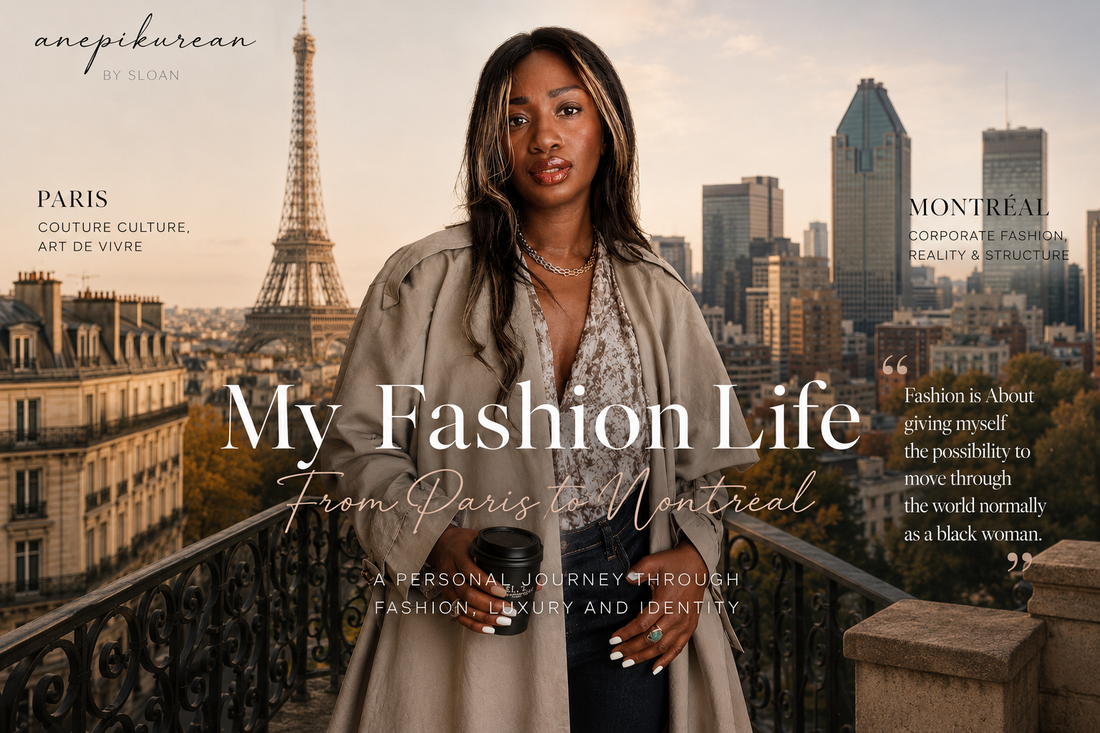
My Fashion life From Paris to Montreal
A Personal Journey Through Fashion, Luxury and Identity
Along my life in Fashion From Paris to Montreal , Certain people often ask me why I speak about Fashion with so much emotion . And honestly, I think it is because fashion was never something distant or aspirational in my life.
It was simply… normal.
I grew up following my mother to work in the Sentier district of Paris, surrounded by workshops, fabrics, industrial sewing machines and women working endlessly behind collections that people would later admire in boutiques without ever imagining the labor behind them. Today, my mother works on couture pieces for Chanel, contributing to garments later seen at events as visible as the Met Gala.
As a child, she would keep me quietly in the back of the ateliers while she worked. I played with fabrics,needles, trims,buttons,ribbons,mercerie accessories scattered everywhere. We had threads in our pockets. Pins on tables. Fabric dust floating in the air.
Fashion did not feel glamorous to me then. It simply felt alive and sometimes exhausting.
We Did Not Have A Sofa Because The Sewing Machine Came First
One memory still makes me smile. In our small apartment, we did not even have a sofa at some point because otherwise the industrial sewing machine would not fit inside. That machine occupied the room like another family member. And somehow, this felt completely normal to us and even to the wealthy women who used to come for the fitting.
At thirteen years old, I was already walking around Paris with my little Furla bags, and when we travelled, I carried my belongings inside a Louis Vuitton Travel bag.
Luxury in Paris was never presented to me as something untouchable. It circulated naturally through people’s lives.
Fabric Stores Were My First Luxury Boutiques
My mother was both a seamstress and a personal shopper. Some of my earliest memories are of sitting quietly inside the luxury boutiques of Le Bon Marché while she selected pieces for her clients before walking elegantly to the register to pay on their behalf.
Very early in life, I found myself as a Black child moving through wealthy Parisian environments that felt far less accessible at the time than they do today. And yet, despite not growing up rich, I was always impeccably dressed. Presentation mattered deeply in our world.
As I grew older, my mother slowly started trusting me with errands of my own. And the lists were serious. I would leave carrying handwritten notes asking for:
- four meters of mousseline,
- invisible zippers,
- eyelets,
- thread for alterations,
- five meters of off-white satin,
- beige lining fabrics,
- couture notions.
And somehow, I never got anything wrong. Before I understood luxury branding, I understood fabrics. I knew quality through touch long before I knew the language of marketing. I could recognize structure, softness and craftsmanship with my hands before I ever learned how the fashion industry sold aspiration through image.
Even today, I still believe my real fashion education began in fabric stores and ateliers long before it began online or inside classrooms.
“Old organic fabrics have a smell of their own. The sewing machine was always too loud, and I stepped barefoot on needles more times than I can count. My mother never formally taught me how to sew — but the moment I started, I was already excellent.”
In Paris, Fashion Is Part Of Daily Life
What many people misunderstand about Paris is that fashion there often feels incredibly casual despite its sophistication.
Today, much of what people call “fashion influence” online is simply everyday Parisian culture repackaged for social media. In Paris, editorial style is rarely “too much.” It blends naturally into ready-to-wear and daily life. Women wear beautiful pieces while taking the metro, grocery shopping or sitting alone at a café without trying to perform elegance for attention.
Fashion belongs to the rhythm of the city itself. It is part of the Parisian art of living.
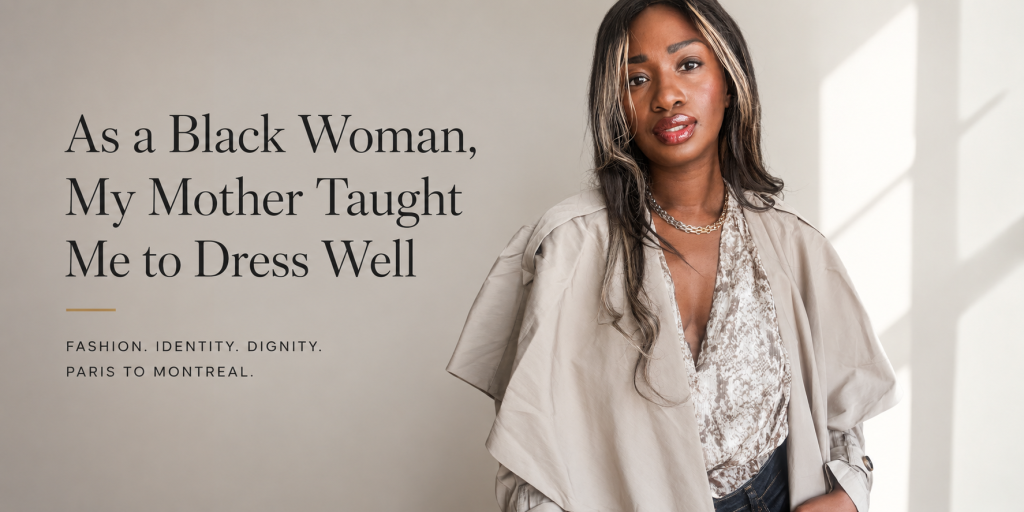
But my relationship to clothing was also shaped by something much deeper than Parisian aesthetics. As a Central African woman, I grew up understanding very early that clothing influences social perception. Style was never presented to me as something superficial. It was a tool. A language. A way to move through different spaces safely and correctly.
I learned how to blend in where I needed to go. And honestly, I grew up knowing that as a Black woman, I could not allow myself to look careless. I understood very young that presentation could change the way people spoke to you, welcomed you, respected you or even perceived your intelligence and background.
So when I dress well and choose the right cuts, the right colors, when not a single thread is out of place it is not only about fashion.
It is also about dignity, control , social ease.
Fashion is About giving myself the possibility to move through the world normally as a black woman.
Read more on the topic on medium.com
I Grew Up Around Luxury Without Fully Realizing It
Looking back now, I realize how unusual some experiences actually were. I owned three Birkin bags in my collection since 2014 through friendships and connections with people working around the industry. And honestly, at the time, it did not feel shocking.
That is another thing about Paris. Luxury often circulates socially before it becomes aspirational online.
A friend knows someone.
Someone works at a house.
An arrangement happens.
A piece changes hands quietly.
In Paris, fashion relationships often exist inside networks people never publicly discuss.
Why Did I Study Fashion In Montreal?
I studied Fashion in Montreal mostly because of circumstance. Thanks to my father’ side , I was born a Canadian citizen . So I was already living here and searching for the academic path that felt closest to my ambitions. So I studied fashion marketing and arts marketing at LaSalle College Montréal.
But honestly? At the time, I still dreamed almost exclusively about Paris.
I wanted couture houses , Fashion weeks , Creative direction and Luxury environments.
From Montreal, I used to watch documentaries about Lanvin and admire Alber Elbaz endlessly. Years later, during COVID, I unexpectedly crossed paths with him at the American Hospital of Neuilly where I briefly worked after lockdown.
I welcomed him into the MRI section. A short time later, he passed away in that same hospital. That moment stayed with me deeply , because he was nice and dynamic. And this how Fashion becomes human again. Fragile, Real and Temporary.
Paris Taught Me To Dream
After my studies, I immediately went back down to Paris because I wanted to enter couture houses. I needed intensity and Paris truly moves differently.
Fashion Week never fully stops there. When you exit George V station, it is normal to see models rushing to castings and celebrities casually walking through familiar streets.
Seeing Kendall Jenner near a restaurant barely surprises people after a while. You can end up at a last-minute VIP dinner because a friend working in finance suddenly says: “Come with us tonight.” And before you realize it, you are sharing a drink with people you once only saw in magazines even if you can’t recall their names.
I obtained several contracts almost accidentally that way. One opportunity quickly became another. Paris moves fast if you know how to move with it. So dress nice from the morning.
Working In Luxury Means Working Hard
People romanticize luxury enormously. But behind the image, people work relentlessly. During Fashion week and as a stylist and seamstress I worked until 11 PM because a runway show was happening in fifteen hours and merchandise had just arrived.
While working at stores , Someone suddenly announces: Cardi B finally arrived, Lily-Rose Depp came to collect merchandise, and another colleague casually says: “Meuf , You just missed 50 Cent.” And everyone simply keeps working. That is Paris too. Intensity becomes normal. And start to you realize only once you leave Paris.
Then Montreal Showed Me Another Side Of Fashion
What surprised me most in Montreal was discovering fashion through a much more corporate lens. Here, fashion often feels operational , pragmatic and disciplined.
People speak authoritatively while dressed extremely casually. But Still , reputation at work matters enormously. And despite the lower glamour compared to Paris, working conditions can actually be excellent.
Montreal introduced me to inventory realities and operational consistency.
The basics here are often produced with remarkable precision. There are fewer events.
Less PR culture and less spontaneous social mixing.
Fashion approaches itself with more caution here. Sometimes even with modesty.
But Montreal taught me something Paris never fully could: how fashion companies survive operationally.
Building My Own Perspective Between Both Cities
When I launched my own label in Paris , I learned something important very quickly: talent attracts lots of attention, And I learned the hard way that business knowledge sustains longevity.
Today, my perspective on fashion is no longer only emotional or aesthetic. It is global.
I understand both the dream, and the machine behind the dream.
And honestly, what I want to bring to Montreal today is very simple. I want to combine:
- stronger marketing methods,
- digital visibility,
- visual coherence,
- branding,
- and style education for women.
Not superficial transformation. But the feeling of a new beginning through image, structure and confidence. Because at its best, is never only about clothing. It is about identity. And you dress for your success.
Need an outside perspective?
I help entrepreneurs and emerging brands improve positioning, validate demand and prepare for growth.
📧 hello@anepikurean.com