Montreal Fashion vs Paris: what are the Key Differences
Montreal Fashion vs Paris ? Montreal fashion and Paris fashion are often compared — yet they operate on fundamentally different systems.
At first glance, both industries share a common language: creativity, design, and the constant pursuit of relevance. However, behind the scenes, the way fashion brands are built, structured, and managed reveals two completely different realities.
In Paris, fashion is not just an industry — it is a cultural institution shaped by history, heritage, and deeply rooted savoir-faire.
In Montreal, fashion is more agile, emerging, and driven by adaptability, where brands must navigate smaller markets and tighter operational constraints.
As a result, the internal structure of fashion brands — from operations to decision-making — differs significantly between the two ecosystems.
→ Explore how Montreal fashion brands strategically operate (insider perspective)
From creative direction and public relations to systems, workflows, and business mindset, these differences go far beyond aesthetics. They define how brands grow, scale, and sustain their position in the market.
In this article, we explore how Montreal fashion differs from Paris — not only in creative culture, but in the systems and structures that shape the industry from within.
Montreal Fashion vs Paris: Two Very Different Fashion Ecosystems
While both cities share a passion for fashion, they operate within fundamentally different ecosystems shaped by scale, history, and global influence.
A Creative Industry vs A Cultural Institution
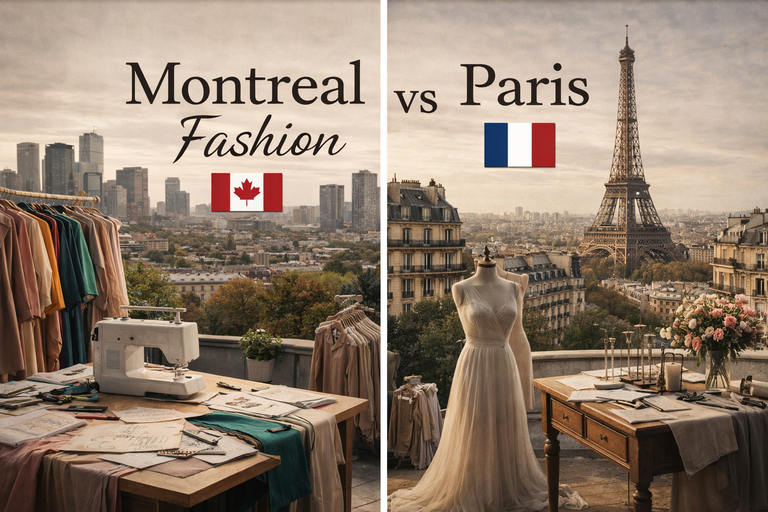
In Montreal, fashion operates primarily as a creative industry — driven by innovation, individuality, and emerging talent. Brands often evolve organically, shaped by market realities and the need to adapt quickly.
In contrast, Paris represents a cultural institution where fashion is deeply embedded in history, tradition, and national identity. It is not only about creating collections, but about preserving codes, heritage, and a long-standing legacy that continues to define global standards.
Scale, History, and Global Influence
The difference in scale between Montreal and Paris plays a major role in how their fashion industries function. Paris benefits from decades of global dominance, supported by established luxury houses, international visibility, and a powerful media presence.
Montreal, while creative and dynamic, operates on a smaller scale with more limited global exposure. As a result, brands must often rely on agility and niche positioning rather than large-scale influence.
Why Montreal and Paris Operate on Different Levels
These differences ultimately come down to structure and ecosystem maturity. Paris has built a fully integrated fashion system over time — combining education, craftsmanship, production, media, and global distribution.
Montreal, on the other hand, is still evolving as a fashion hub, with fewer institutional frameworks and a more fragmented ecosystem. This leads to different ways of working, where
Montreal Fashion vs Paris : Creative Culture: Expression vs Heritage
Creative direction in Montreal and Paris is driven by distinct cultural foundations, influencing how brands design, position, and express their identity.
Montreal Fashion: Innovation, Diversity, and Emerging Identity
Montreal fashion is defined by its openness and diversity, drawing influence from multiple cultures, backgrounds, and creative disciplines. Rather than following established codes, brands often experiment with identity, blending aesthetics and redefining what contemporary fashion can be.
This freedom allows for innovation, but it also reflects an industry that is still shaping its voice — one that evolves continuously rather than relying on a fixed heritage.
Paris Fashion: Legacy, Codes, and Timeless Authority
Paris fashion is built on a foundation of legacy and deeply rooted codes that have been refined over decades. Every collection, silhouette, and detail often reflects a continuity of tradition, where innovation exists within a structured framework.
This balance between heritage and evolution gives Paris its authority, allowing brands to remain relevant while maintaining a strong, recognizable identity that transcends trends.
The Role of History in Shaping Creative Direction
History plays a fundamental role in how fashion is conceived in Paris, where past references, archives, and craftsmanship inform present-day creation. Designers do not create in isolation — they build upon a lineage.
In Montreal, creative direction is less constrained by history, offering more freedom but also requiring brands to define their identity without the support of a long-standing cultural narrative. As a result, creativity becomes both an opportunity and a responsibility.
Internal Operations: Structure vs Flexibility
Beyond aesthetics, the internal organization of fashion brands reveals a clear contrast between structured systems in Paris and more flexible, adaptive approaches in Montreal.
How Montreal Fashion Brands Operate Internally
Montreal fashion brands typically operate with lean structures, where teams are small and resources are limited.
As a result, individuals often take on multiple responsibilities, moving between creative, operational, and commercial tasks on a daily basis.
- Lean Teams : Most Montreal-based brands function with compact teams, allowing for flexibility but also creating pressure on internal resources.
While this structure encourages agility, it can also limit the ability to scale efficiently without strong systems in place.
- Multitasking roles: Employees often handle overlapping roles — from order management to client communication and logistics coordination.
This multitasking approach supports day-to-day operations, but it can also lead to inconsistencies when processes are not clearly defined. - Reactive systems : Many operations are handled reactively rather than proactively.
Decisions are often made in response to immediate needs — such as order issues or stock discrepancies — instead of being driven by structured workflows and long-term planning.
How Paris Fashion Houses Are Structured
In contrast, Paris fashion houses operate within highly structured environments, where each function is clearly defined and supported by established systems.
- Specialized Departments :Teams are divided into specialized departments — including design, production, merchandising, operations, and communications.
This segmentation allows for deeper expertise and greater efficiency across each stage of the business.
- Established Workflows: Processes are standardized and documented, ensuring consistency from product development to final delivery.
Each step follows a predefined structure, reducing errors and improving overall operational control.
- Hierarchy and Precision : Decision-making follows a clear hierarchy, with defined roles and responsibilities.
This level of precision enables coordination across teams and supports the execution of complex operations at scale.
Systems vs Improvisation: A Key Operational Difference
Ultimately, the core difference lies in how operations are approached.
Paris fashion relies on systems — designed, tested, and refined over time — while Montreal often relies on improvisation and adaptability.
While flexibility can be an advantage, the absence of structured systems can limit consistency and growth.
In contrast, strong operational systems provide the foundation needed to scale, maintain quality, and support long-term success.
Systems and Processes: Why Structure Defines Paris Fashion
In Paris, systems are not optional — they are deeply embedded in how brands operate, ensuring consistency, precision, and long-term scalability.
Established Systems in French Fashion Houses
- Production pipelines: Production follows clearly defined pipelines, from design development to final manufacturing. Each stage is planned, sequenced, and monitored, allowing brands to maintain quality while managing timelines effectively.
- Validation processes : Every step undergoes validation before moving forward — whether it is design approval, material selection, or production readiness. This layered approach reduces errors and ensures that decisions are aligned with the brand’s standards.
- Quality control : Quality control is integrated throughout the entire process, not just at the end.This continuous monitoring guarantees that products meet high expectations, reinforcing the brand’s reputation and long-term value.
Operational Challenges in Montreal Fashion Brands
- lack of standardized systems : Processes are often not fully standardized, leading to inconsistencies in how tasks are executed. Without clear frameworks, operations depend heavily on individuals rather than systems.
- reliance on manual processes : Many workflows rely on manual input, from order entry to inventory tracking. This increases the risk of errors and slows down operations, especially as the business grows.
- scalability limitations : Without strong systems in place, scaling becomes difficult.What works for a small brand can quickly become inefficient when order volume and complexity increase.
Why Systems Are Essential for Growth
Ultimately, systems are what transform a fashion brand into a scalable business.
They create structure, reduce uncertainty, and allow operations to run consistently regardless of growth.
Without systems, brands remain reactive and limited.
With systems, they gain control, improve performance, and build a foundation for long-term expansion.
Case Study: Frank And Oak vs Sézane — Similar Positioning, Different Systems
At first glance, brands like Frank And Oak and Sézane appear to share a similar positioning. Both embrace a modern, lifestyle-driven aesthetic, offering curated wardrobes designed for everyday wear. Their branding emphasizes simplicity, storytelling, and a direct-to-consumer approach, appealing to an urban, style-conscious audience.
However, beyond this apparent similarity, their internal structure, visibility, and operational systems reveal fundamental differences.
Sézane has built a strong brand authority through highly controlled storytelling, consistent product strategy, and a powerful presence in editorial and media spaces. Its operations are structured, with carefully planned product drops, refined customer experience, and systems that support both growth and consistency. This level of organization allows the brand to maintain a clear identity while scaling effectively on an international level.
In contrast, Frank And Oak reflects many of the strengths and challenges of Montreal fashion. While the brand offers a solid product and a clear positioning around sustainability, it operates within a more flexible and evolving system. This often results in less consistent visibility, more frequent repositioning, and operational complexity that can limit long-term scalability.
Ultimately, the difference between the two is not defined by product quality, but by structure.
It highlights how French brands leverage systems and public relations to build lasting authority, while Montreal brands, although innovative and agile, often operate with fewer structural advantages on a global scale.
Montreal Fashion vs Paris : Public Relations and Brand Power
Visibility plays a crucial role in fashion, and the way brands leverage public relations differs significantly between Montreal and Paris.
The Power of PR in Paris Fashion
- press relationships
- editorial presence
- fashion week dominance
Montreal Fashion and Limited PR Infrastructure
- smaller media exposure
- local vs global reach
Why Visibility Shapes Brand Authority
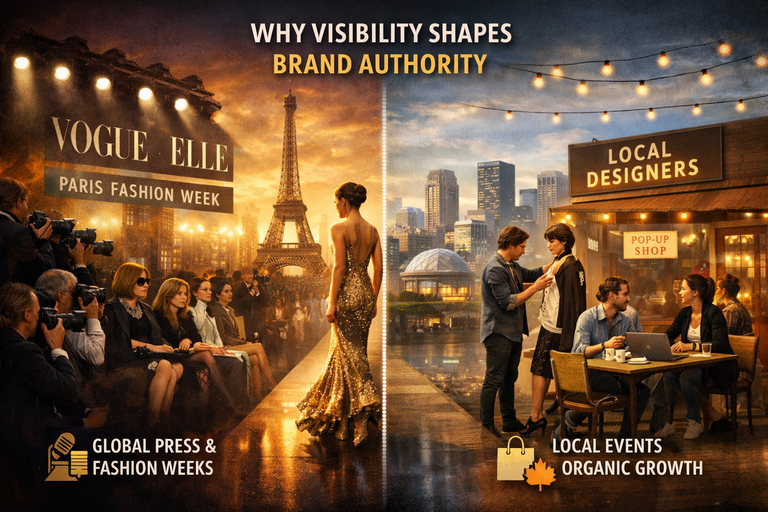
In fashion, visibility is not just about exposure — it is a key driver of authority.
Brands that are consistently present in media, editorials, and industry conversations are perceived as more credible, more established, and ultimately more desirable.
In Paris, visibility is strategically built through strong public relations networks, fashion week presence, and long-standing relationships with press and institutions.
In contrast, Montreal brands often operate with more limited access to these channels, relying on organic growth and local exposure.
As a result, visibility directly influences how a brand is perceived — not only by consumers, but also by buyers, partners, and the industry as a whole.
Craftsmanship and Savoir-Faire
Craft and expertise remain at the core of French fashion, while Montreal follows a more hybrid and pragmatic production approach.
French Savoir-Faire as a Competitive Advantage
- artisanal expertise
- luxury heritage
- transmission of skills
Production Models in Montreal
- hybrid production
- cost-driven decisions
- outsourcing
The Link Between Craft and Brand Value
In fashion, craftsmanship is not only a matter of quality — it is a key driver of brand value.
In Paris, savoir-faire is deeply embedded in the identity of fashion houses, where artisanal expertise, attention to detail, and precision are consistently reflected in the final product.
This level of craft creates more than garments; it builds perception.
Consumers associate craftsmanship with authenticity, heritage, and long-term value — elements that justify higher price points and reinforce brand authority.
In contrast, when craftsmanship is less emphasized or inconsistently integrated, the perceived value of a brand can weaken.
Without a strong link between product and expertise, differentiation becomes more difficult, especially in a competitive market.
Ultimately, craftsmanship acts as a silent signal of excellence.
It not only enhances the product itself, but also elevates the brand’s positioning, making it more desirable, credible, and enduring over time.
Business Mindset: Strategy vs Survival
Fashion brands in Montreal and Paris operate with different business priorities, reflecting their respective market conditions and long-term visions.
Montreal Fashion Brands: Agility and Adaptation
Montreal fashion brands operate with agility, constantly adapting to market constraints and evolving demands.
This flexibility supports innovation, but often comes at the expense of long-term structure.
Paris Fashion Houses: Long-Term Strategic Vision
Paris fashion houses are built on long-term vision, where decisions are guided by heritage, positioning, and continuity.
Strategy is designed to sustain relevance and authority over time, not just short-term performance.
Scaling vs Sustaining Prestige
While Montreal brands focus on scaling within limited resources, Paris brands prioritize sustaining prestige and brand value.
This difference reflects two distinct approaches: growth through adaptation versus growth through controlled legacy.
Montreal Fashion vs Paris: Why These Differences Exist
These contrasts are not accidental — they are rooted in historical, economic, and institutional differences between the two regions.
Historical Foundations of the Paris Fashion Industry
Paris fashion is built on decades of history and global influence.
Its legacy of haute couture and established fashion houses has shaped not only its aesthetics, but also its highly structured way of operating.
Economic and Market Differences in Canada
Canada’s fashion market is smaller and more constrained, with limited scale and fewer global players.
As a result, brands often prioritize flexibility and cost-efficiency over long-term structural investment.
Ecosystem Support, Institutions, and Infrastructure
Paris benefits from a strong, interconnected ecosystem of institutions, media, and global events.
In Montreal, the ecosystem is still developing, offering fewer centralized structures to support large-scale growth.
What Montreal Fashion Can Learn from Paris
Rather than a limitation, these differences reveal clear opportunities for Montreal fashion brands to evolve and strengthen their positioning.
One of the most important lessons lies in building stronger systems.
Paris fashion houses operate with structured workflows, from production to delivery, allowing for consistency and scalability.
By contrast, many Montreal brands can benefit from formalizing their processes to reduce inefficiencies and support long-term growth.
Another key area is brand positioning and public relations.
Paris brands invest heavily in visibility, leveraging media, storytelling, and strategic presence to reinforce their authority.
Montreal fashion can elevate its impact by developing a more intentional approach to PR and brand image.
Finally, the transition from creative brands to structured businesses is essential.
While creativity remains a strength, sustainable growth requires organization, systems, and strategic thinking.
Moving beyond purely creative identity allows brands to build not only aesthetic value, but also operational strength and long-term credibility.
Final Thoughts: Two Models, Two Strengths
Ultimately, both ecosystems bring unique strengths, and understanding their differences offers valuable insight into the future of fashion.
Montreal stands out for its innovation, flexibility, and potential — a space where creativity evolves freely and new identities continue to emerge.
Paris, on the other hand, embodies structure, legacy, and authority.
Its strength lies in its ability to sustain excellence over time, supported by systems, heritage, and a deeply rooted cultural foundation.
The future of fashion may not lie in choosing one model over the other, but in bridging the two.
Combining creativity with structure, and flexibility with strong systems, offers a path toward building brands that are not only inspiring, but also sustainable and scalable.
What to conclude on key differences between Montreal Fashion vs Paris
While Montreal and Paris operate under different systems, these differences also reveal clear opportunities for growth.
→ Discover 10 Things Montreal Fashion Must Learn from Paris to Truly Compete Globally